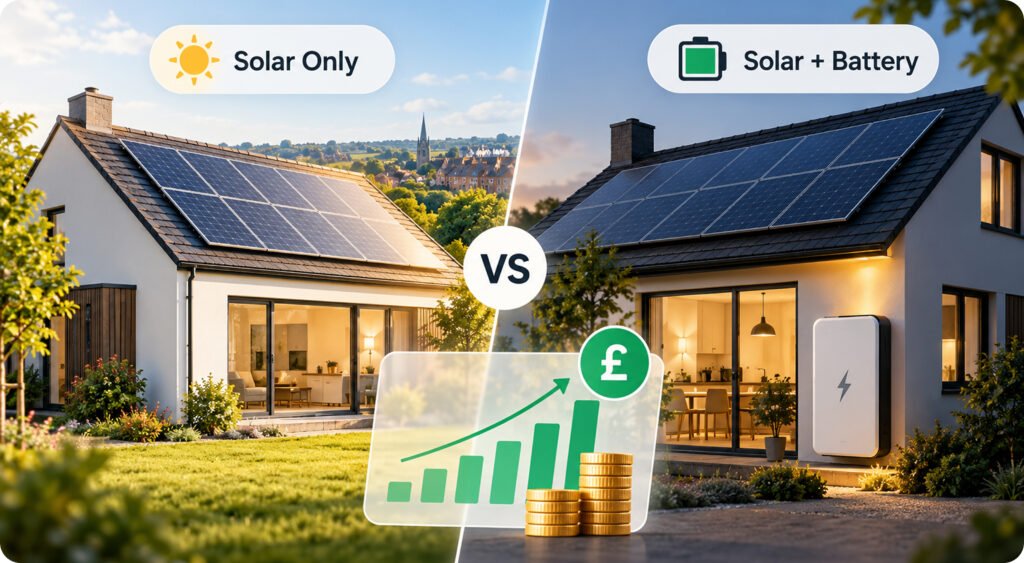
For most UK homes, solar panels alone give the fastest payback, while adding a battery raises self-consumption from roughly 35% to 60% or more but extends payback by a few years. A battery makes the most sense when you are out during the day, export rates are low, or you can use a smart time-of-use tariff.
Solar panels produce power at midday. Many households are out then, so a lot of what the panels generate is exported to the grid at a low rate and bought back later at the full price. A battery stores the surplus so you can use it in the evening instead.
That is the whole trade: a battery turns cheap exports into avoided expensive imports. The question is whether the gap is big enough to justify the cost.
Typical installed cost
About £6,100 to £7,300 for a typical home
Add about £2,500 to £5,500 for 5 to 10kWh
Self-consumption.
About 30 to 40%
About 55 to 80% depending on battery size
Exported to grid
Roughly 50 to 60%
Much lower
Published payback
About 7 to 10 years
About 9 to 12 years
Evening and overnight cover
None
Yes, up to the battery's usable capacity
Power cut backup
No
Only with specific backup-capable hardware
Inverter
Standard string, optimiser or microinverter
Hybrid, or battery-compatible setup (see inverter types)
Best for
Home during the day, tight budget, simple roof
Out in the day, high evening use, EV or heat pump, smart tariff
Payback figures come from published 2026 comparisons and vary by installer, tariff and household. One analysis puts combined solar and battery payback near 7 years, so treat the range as a guide, not a promise.
These figures are an illustration using round numbers, not a quote.
Assumptions: a 4kWp system generating 3,800kWh a year (the middle of the 3,400 to 4,200kWh range usually quoted for 4kW in the UK), an import price of 26.32p per kWh (the Ofgem price cap for October to December 2026), and self-use of 35% without a battery.
Solar only, export at 4p
About £450
Solar only, export at 12p
About £645
Now add a 5kWh battery that lifts self-use from 35% to about 60%. That moves roughly 950kWh a year from export to avoided import.
4p per kWh
About £210 a year
12p per kWhp
About £135 a year
At a battery cost from around £2,500, that is a simple payback of roughly 12 to 18 years on solar self-use alone. That is slower than the panels themselves. Two things can improve it: a better tariff (see below) and electricity prices rising, which would raise the value of every unit you avoid buying.
The honest conclusion is that a battery rarely beats the panels on pure payback. It earns its place for other reasons.
Smart Export Guarantee rates vary hugely. Fixed rates from suppliers are often in the low single digits, with the best fixed offers around 12 to 16p, and some time-of-use tariffs pay much more at peak times, but several of those require a battery or a particular import tariff. In 2026 the headline range runs from about 12p to over 30p for battery-linked tariffs, with strings attached.
If you can get a decent flat export rate, solar only looks better. If your export rate is poor, a battery looks better, because every unit you store replaces an import costing about 26p rather than earning a few pence.
The 0% VAT rate on solar and batteries runs until 31 March 2027. Ask any installer to confirm in writing how the rate applies to your install date. Our guide on installing in autumn covers the timing in more detail, and whether solar pays off in winter shows where the battery helps most.
For the wider “is it worth it” question, see our guide to whether solar batteries are worth it.
The fastest way to see what a fair local price looks like is to compare several vetted quotes for your own roof. SolarForYou lets you compare quotes from MCS-certified installers in your area, so you can judge price, warranty and system design together before you commit
Not on payback alone. Solar only usually repays faster, with published figures around 7 to 10 years versus 9 to 12 for solar plus battery. A battery raises self-consumption and gives evening cover, so it suits households out in the day, with high evening use, or with a time-of-use tariff.
Published 2026 figures put a 5 to 10kWh battery at roughly £2,500 to £5,500 on top of the panels. Final cost depends on capacity, brand and whether the inverter is already battery-compatible. Both solar and batteries are zero-rated for VAT until 31 March 2027.
Typically around 30 to 40%, with the rest exported. Adding a battery can lift that to roughly 55 to 80%, depending on its size and your usage pattern.
Yes. Retrofit batteries have been zero-rated for VAT since 1 February 2024. Fitting both together is often cheaper and simpler, and it is worth checking now whether your inverter would support a battery later.
Yes. Batteries work year-round, but with less solar generation in winter they charge less from the panels. Many owners charge them from cheap overnight electricity on a time-of-use tariff instead.