The right solar inverter depends on your roof, not a universal “best” answer. String inverters suit simple, unshaded roofs and the lowest budget. Microinverters suit shaded or multi-aspect roofs. Hybrid inverters suit anyone adding a battery now or later. Get this choice wrong and even excellent panels underperform.
Solar panels generate direct current (DC) electricity. Your home, and the grid, run on alternating current (AC). The inverter’s core job is converting one into the other — but modern inverters also handle system monitoring, safety shutoffs, export limiting, and increasingly, battery and EV charger management. It’s the component that decides how intelligently your system behaves, not just whether it works.
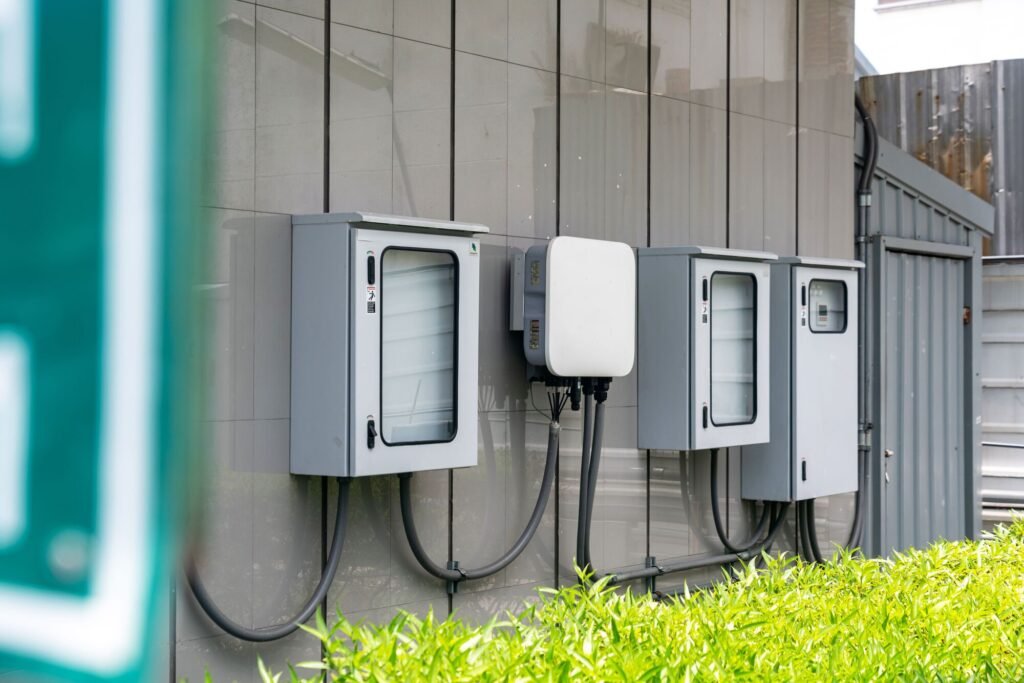
One central inverter, with panels wired together in a “string” feeding into it. This is the simplest, cheapest, most established technology, and it works very well on a clear, unshaded, single-aspect roof.
The catch: a string inverter’s output is limited by the weakest-performing panel in that string. Shade even one panel and the whole string’s output drops — sometimes drastically. See our guide on [solar panel shading] for the exact mechanics.
A small inverter is fitted behind every individual panel, converting DC to AC right there on the roof. Each panel operates completely independently — a shaded or underperforming panel doesn’t affect any other panel in the array.
The catch: more electronics on the roof means more components that could eventually need attention, and rooftop access makes servicing an individual unit more involved than servicing a single ground-level inverter.
Built to manage both solar panels and a battery from a single unit, with smart energy management, deciding in real time whether to send power to your home, into the battery, or out to the grid. Increasingly the default choice for UK installs, since battery storage has become a standard add-on rather than an afterthought.
The catch: a higher upfront cost than a basic string inverter, though usually less than retrofitting battery-compatible equipment later.
Not a fourth inverter type exactly — optimisers pair with a central string inverter, with a small unit behind each panel that hunts for that panel’s individual maximum power point before passing power downstream. You get most of the shading resilience of microinverters, with the simpler servicing of one central inverter. SolarEdge is the best-known brand in this category.
String inverter
Simple, unshaded roofs
Low
Sometimes, via add-on
System-level
Lowest
Power optimisers
Some shading, want central servicing
High
Sometimes, via add-on
Panel-level
Mid
Microinverters
Shaded or complex, multi-aspect roofs
Highest
Usually via add-on
Panel-level
Highest
Hybrid inverter
Battery now or planned
Depends on pairing
Yes, built-in
System + battery
Mid–high
If yes, microinverters or power optimisers should be on your shortlist. If no, a string inverter is likely sufficient.
If yes, a hybrid inverter (or a string/optimiser setup confirmed as battery-compatible) saves a retrofit later.
Multiple strings on separate MPPT inputs, microinverters, or optimisers all handle this better than a single basic string inverter.
A standard string inverter delivers excellent value with no meaningful performance trade-off in that specific scenario.
Recognised brands operating in the UK residential market include SolarEdge and Tigo for power optimiser systems, Enphase for microinverters, and GivEnergy, Fox ESS, SolaX and Sungrow among the hybrid/battery-inverter brands frequently paired with UK battery storage. Brand reputation matters less than whether the specific model is correctly matched to your panels, your roof, and your battery plans — ask your installer to justify the pairing, not just name the brand.
Inverters typically carry shorter warranties than panels — commonly 10 to 12 years as standard, extendable to 20–25 years on some premium models, compared with a panel’s usual 25-year performance warranty. In practice, an inverter is more likely than a panel to need replacement within the system’s lifetime. Factor that into total cost of ownership, not just the upfront price.
MCS verified , Free, no obligation, no charge to unlock quotes. Tell us about your property once and we will match you with up to three certified installers in your area.
There isn’t a single best type — it depends on shading, roof layout and battery plans. String inverters suit simple, unshaded roofs; microinverters or power optimisers suit shaded or multi-aspect roofs; hybrid inverters suit anyone with a battery now or planned.
Not necessarily, but if you’re likely to add a battery within the system’s lifetime, a hybrid inverter avoids a retrofit cost later. If a battery isn’t in your plans at all, a standard string inverter is more cost-effective.
Typically 10 to 12 years as standard, with some premium models warrantied to 20–25 years. This is usually shorter than a panel’s 25-year performance warranty, so most systems will need at least one inverter replacement or refurbishment over their lifetime.
On a shaded or complex, multi-aspect roof, yes — the performance gain can be substantial. On a clear, unshaded, single-aspect roof, the extra cost buys little practical benefit over a standard string inverter.
Both give panel-level performance monitoring and shading resilience. A microinverter converts DC to AC at each panel individually; a power optimiser adjusts each panel’s output but still routes DC to one central inverter for conversion.