Shading even a small part of a solar array can cut its output far more than the shaded area suggests — in a standard string system, shading roughly 9% of one panel can reduce total array output by over 50%, because the whole string drops to match its weakest panel. Microinverters and power optimisers largely solve this, at a modest extra cost.
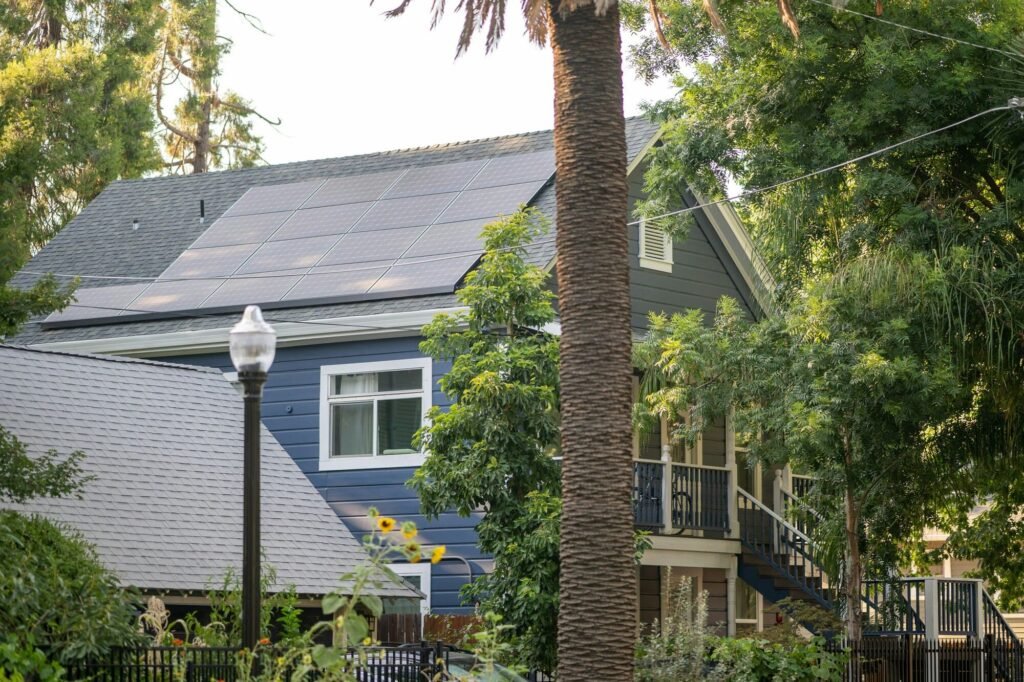
If a chimney, a neighbour’s tree or a dormer window throws shade across part of your roof, this is what it actually costs you — and what to do about it.
In a traditional string system, panels are wired together in series and feed one central inverter. That inverter can only draw current at the rate the weakest-performing panel in the string allows. Shade one cell hard enough — a chimney shadow, bird droppings, a stray leaf — and that panel’s voltage drops sharply to protect itself. Because the whole string is chained together, every other panel in that string gets pulled down to match it, even though they’re sitting in full sun.
This is why shading damage is disproportionate: losing 9% of one panel’s surface area to shade doesn’t cost you 9% of that panel’s output — it can cost you over half the output of the entire string it’s wired into.
Not all shade behaves the same way:
A chimney, a satellite dish, a solid object — creates a sharp on/off shadow. This is the type that triggers the steepest voltage drops.
A distant tree branch, thin cloud, haze — reduces light more gradually and causes a smaller, more proportional dip in output.
Bypass diodes built into modern panels help contain hard-shade damage to the affected panel rather than the whole string, but they don’t eliminate the loss — they just stop it spreading as far.
Each panel gets its own small inverter, converting DC to AC individually right at the panel. A shaded panel’s reduced output simply reduces its own contribution — it has no way to drag down panels that are still in full sun. This is the most complete technical fix for shading, at the cost of more electronics on the roof (and, if one fails, an access job to reach it).
A small unit sits behind each panel and continuously hunts for that panel’s individual maximum power point, then passes DC downstream to a single central inverter. You still get panel-level independence — a shaded panel doesn’t drag the string down — while keeping one central inverter, which is simpler to service than rooftop microinverters.
If your shading follows a predictable pattern — say, one roof aspect shaded in the morning, another clear all day — wiring each aspect to its own MPPT input on a standard string inverter can isolate the problem without the cost of full panel-level electronics. This won’t help with shade that moves across a single string throughout the day, only shade that consistently affects one physical group of panels.
Sometimes the simplest fix is keeping the shaded area out of the array altogether — designing around a chimney or dormer rather than through it, or having overhanging branches cut back before installation. Cheaper than any electronics, when it’s possible.
Heavily shaded roof, multiple obstructions, shade moves through the day
Microinverters
Some shading, want panel-level monitoring with simpler roof electronics
Power optimisers
Shade is confined to one clearly defined roof section
Multi-MPPT string inverter
No meaningful shading at all
Standard string inverter — no premium needed
For a genuinely unshaded, clear south-facing roof, paying for shading-mitigation technology adds cost without adding benefit. It only earns its keep where real shading exists.
MCS verified , Free, no obligation, no charge to unlock quotes. Tell us about your property once and we will match you with up to three certified installers in your area.
It depends on the system type, but the effect is disproportionate. In a standard string system, shading around 9% of a single panel’s surface can reduce the output of the whole string it’s wired into by over 50%, because the string’s output is limited by its weakest panel.
Yes, partially. Diffuse or partial shade reduces output roughly in proportion to the light lost. Hard shade on even one cell can cause a much steeper drop, particularly in a traditional string system without panel-level electronics.
Largely, yes. Because each panel converts its own power independently, a shaded panel’s reduced output doesn’t affect any other panel in the array.
Typically similar in overall system cost, though the details vary by installer and product. Optimisers keep a single central inverter, which some installers and homeowners prefer for servicing; microinverters put more electronics on the roof itself.
No. Microinverters and optimisers solve a specific problem. On a clear, unshaded roof, a standard string inverter performs just as well for less money.