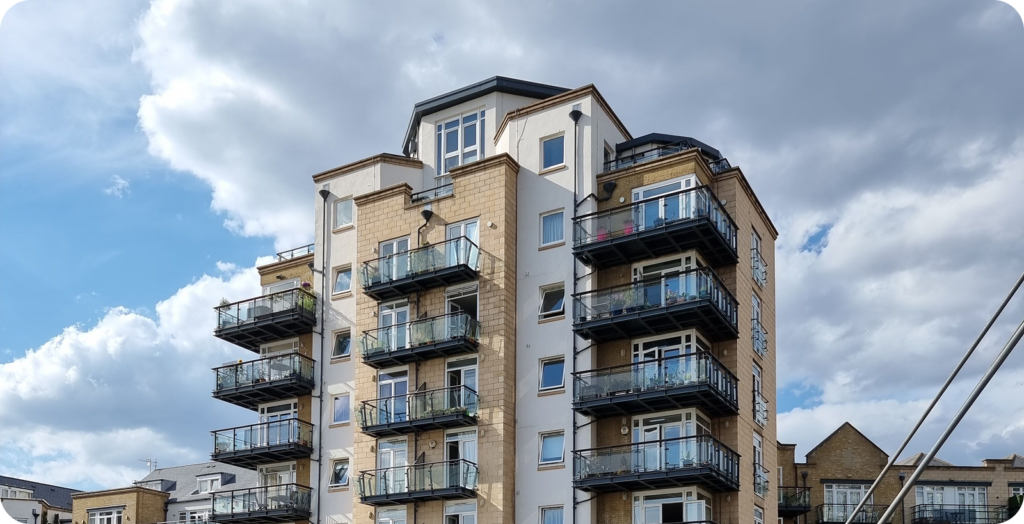
Around 5 million UK households live in flats, and solar guidance has historically been written almost entirely for homeowners with sole ownership of a pitched roof. That’s changing in 2026, driven by two developments: new legal frameworks for plug-in balcony solar, and growing awareness that leasehold properties can access communal rooftop systems with the right approach
This guide covers the three realistic routes to solar for UK flat residents, what permission each one requires, and roughly what each costs. Check the solar panel quotes UK guide
If you own or part-own a leasehold flat, a communal rooftop installation serving the whole block is often the most impactful option — even though you can’t install panels solely for your own unit.
A strong proposal to a freeholder or residents’ management company includes a quote from an MCS-certified installer, projected savings on service charges, the Smart Export Guarantee income estimate, the payback timeline, and confirmation of 0% VAT eligibility (in place until March 2027). Gathering support from 60 to 70 percent of leaseholders before approaching the freeholder carries considerably more weight than an individual request.
Legitimate comparison platforms are free to use. Revenue comes from a referral fee paid by the installer when a job completes, not from the homeowner. If a platform asks for payment to ‘unlock’ quotes or access installer contact details, that is not standard practice in the UK market.
A 10kWp communal system for a residential block costs roughly £12,000 to £18,000 installed, including scaffolding, inverters, and metering. If the system offsets around £1,500 per year in communal electricity costs and earns £400 per year in Smart Export Guarantee income, a ten-unit building typically recovers the investment within 7 to 10 years, after which the saving reduces service charges directly.
Individual units can also benefit through submetering, where each flat receives an allocation of the solar generation proportional to their share of the building.
Plug-in (or balcony) solar panels are small, self-contained systems — typically one or two panels connected to a microinverter — that connect to a standard household socket rather than requiring rooftop installation.
As of April 2026, BS 7671 Amendment 4 formally permits plug-in solar systems up to 800W in the UK. Before connecting one, you’re required to submit a G98 notification to your local Distribution Network Operator — a free, straightforward online form, and a notification rather than an approval request. A new BSI product safety standard is expected from July 2026; look for kits certified to that standard rather than relying on a CE mark alone, since European certification doesn’t guarantee UK compliance.
You own the inside of your flat, but typically not the external walls or balcony structure, which belong to the freeholder. Attaching anything to them — including balcony solar panels — almost always requires written permission, primarily because of liability concerns around storm damage and building insurance. A professional installation by a certified electrician, with public liability insurance, strengthens any request considerably
A basic 800W dual-panel kit costs roughly £600 to £800 excluding panels for the inverter and mounting hardware; complete kits vary from £300 to £800 depending on specification. Government estimates put annual savings at £70 to £110 per year for a typical plug-in system — modest, but achieved without any structural work.
For flat residents where neither a communal rooftop system nor a suitable balcony space is available, community energy scheme membership offers indirect access to solar. These schemes involve investing in or subscribing to a shared solar installation elsewhere — often a larger array on a nearby building or solar farm — with savings credited back to your energy account. Virtual net metering, where a remote community solar installation credits residents’ bills without a physical connection, is being piloted by several UK energy suppliers as of 2026
Read your lease agreement for clauses covering external alterations, roof access rights, and consent requirements — before contacting any installer.
Confirm whether your building is a share-of-freehold arrangement, which changes who needs to approve any installation.
Check if your property is listed or in a conservation area — these require additional permissions (Listed Building Consent, or planning permission for front-facing installations).
For plug-in systems, confirm the kit is BSI-certified once that standard is available from July 2026, and budget for a qualified electrician to fit the required dedicated circuit.
Whatever route you pursue, confirm the installer or system is MCS-certified if you want to access Smart Export Guarantee income.
Yes, but the route depends on your ownership situation. If you’re a leaseholder, you’ll typically need freeholder consent for any rooftop installation, since the roof usually belongs to the freeholder, not individual flat owners — except in the case of a top-floor flat where the lease explicitly grants roof rights. Communal rooftop systems, balcony plug-in panels (legalised for systems up to 800W under BS 7671 Amendment 4, in force from April 2026), and community energy scheme membership are the three main routes available to UK flat residents in 2026.
In most leasehold arrangements, yes. The roof and external walls are typically ‘retained parts’ owned by the freeholder, not the individual leaseholder — even for a top-floor flat, unless the lease explicitly grants roof access rights. Most leases include either a fully qualified or qualified covenant, meaning the freeholder can only refuse consent with reasonable grounds under the Landlord and Tenant Act 1927. If you jointly own the freehold with other residents (a ‘share of freehold’ building), the decision sits with all leaseholders collectively rather than a separate freeholder.
Plug-in (balcony) solar panels are small, self-contained systems — typically one or two panels connected to a microinverter — that connect to a standard household socket without rooftop installation. As of April 2026, BS 7671 Amendment 4 formally permits plug-in solar systems up to 800W in the UK. A G98 notification to your local Distribution Network Operator is required before connecting one — a free, simple online form, and a notification rather than a permission request. Look for kits certified to the UK’s new BSI product safety standard, expected from July 2026, rather than relying on a CE mark alone.
Balcony plug-in solar systems typically save £70 to £110 per year according to UK government estimates, at a system cost of roughly £300 to £800. Communal rooftop systems shared across a block cost considerably more upfront (roughly £10,000 to £50,000 depending on block size) but can offset service charge electricity costs significantly — a 10kWp communal system serving ten flats can pay back within 7 to 10 years through combined bill savings and Smart Export Guarantee income.
Renters have more limited options than leaseholders, since they don’t own the property and typically can’t authorise permanent alterations. Plug-in balcony panels are the most realistic route for renters, provided the landlord consents to a dedicated circuit installation (required for grid-connected plug-in systems) and any balcony fixings. The Renters’ Rights Act 2025 has strengthened tenants’ position when requesting small energy improvements, making these conversations somewhat easier than in previous years.
Abhishek Raikwar

Abhishek Raikwar
Abhishek Raikwar